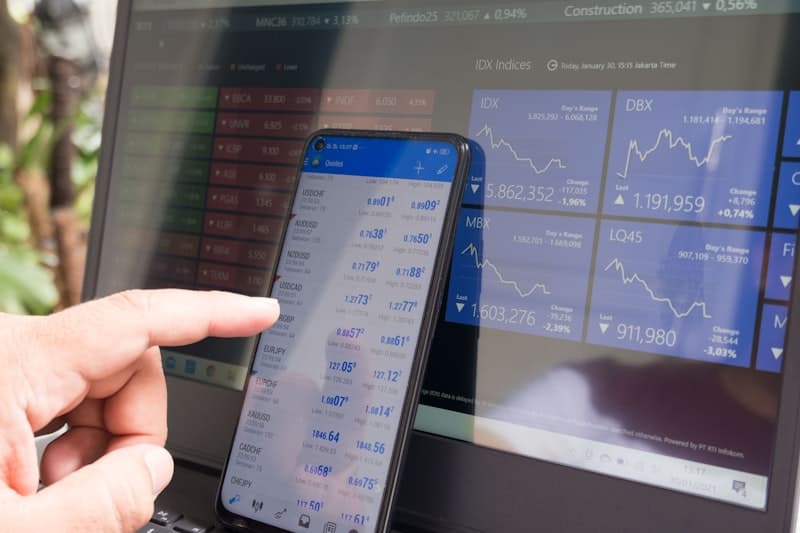
The CME futures market is the most efficient environment for running systematic strategies. NQ, ES, YM and GC concentrate billions of dollars in daily volume, extended hours and minimal spreads — conditions that index CFDs cannot consistently replicate.
Why futures and not index CFDs
The fundamental difference is not the product but the market structure. An E-mini S&P 500 (ES) futures contract is a centralised contract settled on the CME. An S&P 500 CFD is a bilateral bet with your broker as counterpart.
The practical implications are significant:
- Real market depth. The ES order book reflects genuine institutional activity. Technical levels work because everyone sees the same market.
- No re-quotes or discretionary execution. Futures execution is purely electronic. There is no dealing desk that can move your stop.
- Transparent costs. Commission per contract at a quality futures broker is fixed and known. No variable spreads that widen on news.
- Regulated leverage. Futures margin is defined by the CME, not arbitrarily by the broker.
The four main contracts
| Contract | Underlying | Tick size | Value per tick | Main session |
|---|---|---|---|---|
| ES (E-mini S&P 500) | S&P 500 | 0.25 pts | $12.50 | 09:30–16:00 ET |
| NQ (E-mini Nasdaq-100) | Nasdaq 100 | 0.25 pts | $5.00 | 09:30–16:00 ET |
| YM (E-mini Dow Jones) | DJIA | 1 pt | $5.00 | 09:30–16:00 ET |
| GC (Gold Futures) | Gold (troy oz) | $0.10/oz | $10.00 | 08:20–13:30 ET |
Micro contracts (MES, MNQ, MYM, MGC) offer the same access at one tenth the nominal size — ideal for developing and validating strategies with controlled risk.
Session structure: where movement is generated
Index futures have a structured activity pattern that repeats with high consistency:
Pre-market (04:00–09:30 ET)
The Asian and European sessions establish the initial ranges. Session opening levels are critical liquidity references. A gap above the prior close will frequently generate a fill attempt during the first hours of the American session.
American open (09:30–10:30 ET)
Maximum volatility. The first 30 minutes establish the Opening Range (OR) — a zone that defines the direction of the day. OR breakout strategies have the highest consistency ratio in American index futures.
Mid-day (10:30–14:00 ET)
Volume reduction. The market tends to consolidate or fill gaps and Fair Value Gaps left during the open. Entries during this period require additional structure confirmation.
Afternoon (14:00–16:00 ET)
Reactivation before the close. Institutional positions are adjusted ahead of settlement. Futures frequently return to the day's VWAP levels.
Key TradingView indicators for futures
TradingView allows direct trading on CME futures contracts with real-time data. The most relevant tools for this market:
Session Levels and VWAP
Session opening levels are the most important reference for index futures. The daily VWAP acts as a gravitational magnet — price tends to test this level multiple times during the session, especially in ES and NQ.
Liquidity and Order Flow
Equal Highs / Equal Lows in futures are more reliable than in Forex because real market depth validates the concentration of orders. An EQH sweep in NQ within the first 30 minutes of the session, followed by absorption and rejection, is one of the highest probability setups statistically.
Fair Value Gaps in futures
FVGs on the 1 and 5-minute timeframes during the American open have mitigation rates above 70% in ES and NQ. In GC, 15-minute FVGs during the London session are a common reference for institutional entries.
Risk management specific to futures
The implicit leverage of futures makes risk management deterministic, not optional.
Position sizing by margin
Intraday margin for one NQ contract is approximately $1,000–$2,000 depending on the broker. This does not mean the actual risk is that amount — it means that with a $10,000 account you can control one contract that moves $5 per tick with daily ranges of 200–400 points ($1,000–$2,000 per contract).
A conservative practical rule: risk a maximum of 1% of the account per trade. On a $25,000 account trading NQ, that equates to a 50-tick stop ($250) with one contract, or 25 ticks with two contracts.
Correlation between indices
ES, NQ and YM have a correlation above 0.90. Trading all three simultaneously does not diversify risk — it multiplies it. Index strategies should select a primary contract or reduce size proportionally when trading more than one.
GC as a hedge and as independent trading
Gold (GC) has a moderate negative correlation with indices during risk-off periods. A combined strategy that trades GC in the inverse direction to ES during high-volatility sessions can significantly reduce portfolio drawdown.
Automation with Pine Script on TradingView
TradingView allows complete strategies to be programmed in Pine Script v6 and run directly on real-time futures data. The advantages over developing in MQL5 are considerable for the research phase:
- Immediate backtesting with the native strategy engine, no compilation or separate platform required
- Webhook alerts that can connect to futures brokers supporting API orders (Interactive Brokers, Tradovate, Rithmic)
- Native walk-forward from version 6 of the strategy engine
- Native multi-timeframe analysis to confirm signals on higher timeframes
A typical automated strategy development flow for futures:
- Define the hypothesis in plain language: what market condition, in which session, with what confirmation
- Code it in Pine Script with fixed risk management (minimum 1:1.5 R/R)
- Backtest over 2 years of historical data per instrument
- Walk-forward over the last 6 months to validate out-of-sample
- Paper trade for a minimum of 4 weeks before real capital
- Activate webhook alerts connected to the broker
Common mistakes when trading futures from TradingView
The biggest mistake is treating futures as a high-frequency asset when trading manually. Liquidity and volatility are only an advantage with a disciplined entry process.
- Trading without respecting rollover. Futures have quarterly expiry dates. The active contract changes (rolls) and if the symbol is not updated in TradingView the backtest will use data from inactive contracts.
- Ignoring FOMC and macro data. Index futures can move 50–100 points in seconds during employment data or rate decisions. Automated strategies must filter these windows.
- Underestimating the opening gap. The difference between the RTH closing price and the next session's open can invalidate stops calculated on continuous historical data.
Next step
We are developing a set of Pine Script strategies designed specifically for NQ, ES, YM and GC — with integrated risk management, session filters and walk-forward validation. If you want to be among the first to access them, you can join the waitlist.