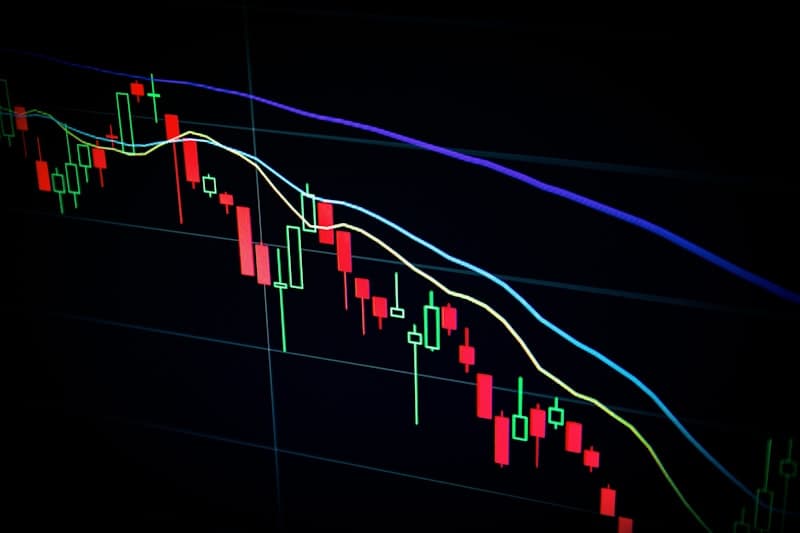
What is a Fair Value Gap
A Fair Value Gap (FVG) — or imbalance — is an area on the chart where price moved so fast in one direction that it left a "gap" without balanced trading between buyers and sellers. In ICT and Smart Money Concepts (SMC) methodology, these gaps represent inefficiencies that the market tends to fill later.
Visually, an FVG appears as a space across three consecutive candles: the body or wicks of candle 1 and candle 3 don't overlap, and candle 2 (the middle one) is the impulse that creates the imbalance.
How an FVG forms (the 3-candle rule)
To identify a bullish Fair Value Gap:
- Candle 1: any candle.
- Candle 2: a strong bullish impulse.
- Candle 3: the gap exists if the low of candle 3 stays above the high of candle 1.
That space between the high of candle 1 and the low of candle 3 is the bullish FVG. For a bearish FVG the logic inverts: the high of candle 3 stays below the low of candle 1.
Bullish FVG:  low[c3] > high[c1]   → gap = (high[c1] , low[c3])
Bearish FVG:  high[c3] < low[c1]   → gap = (high[c3] , low[c1])
Why Fair Value Gaps work
When an institutional move pushes price hard, there's no time for all orders to fill in a balanced way. Unfilled liquidity remains inside the gap. The market, seeking efficiency, tends to return to mitigate (partially or fully fill) that zone before continuing. That return is the entry opportunity: you trade in the direction of the original impulse when price comes back to the FVG.
How to trade an FVG step by step
- Identify structure. First determine bias with Break of Structure (BOS) or Change of Character (CHoCH). FVGs only trade with the dominant structure.
- Mark the impulse FVG. After a BOS, the last imbalance that originated the move is your point of interest (POI).
- Wait for the return. Don't chase price. Let it come back to the FVG.
- Enter with confirmation. A raw FVG has a moderate win rate. Raise it by combining it with another confluence: a 0.62–0.79 Fibonacci level, VWAP, or a prior liquidity sweep.
- Manage risk. Stop on the far side of the FVG (or the swing that created it). Target the next liquidity zone.
The most common mistake
Trading every FVG. A chart has dozens of imbalances and most are irrelevant. The FVGs that matter are the ones that:
- Originate a Break of Structure.
- Coincide with a supply/demand zone or order block.
- Appear after a liquidity sweep of a key high or low.
- Align with the highest-volume session (London / New York).
FVG + confluences: the full system
An isolated FVG is a weak signal. The strength is in confluence. The highest-probability setup combines three factors in the same zone:
- Fair Value Gap — the inefficiency to fill.
- Fibonacci retracement — ideally the gap falls in the OTE zone (0.62–0.79).
- VWAP or session level — confirms price is at value.
When all three align, the probability the bounce works rises notably. Spotting this by hand in real time is slow, which is why automating the detection makes sense.
Detect them automatically on TradingView
We publish several free Pine Script indicators that mark Fair Value Gaps in real time with their status (active / mitigated), plus a confluence indicator that overlays FVG + Fibonacci + VWAP in a single view. Add them to your chart in one click from our free indicators page.
To go deeper on the structure that gives FVGs context, read our guide on Smart Money Concepts and liquidity zones and the one on the best free SMC indicators.
Conclusion
The Fair Value Gap is one of the most powerful tools in SMC trading because it maps exactly where price left an inefficiency. But its real power shows when you filter it by structure and combine it with confluences. Trade few FVGs — the best ones — and in the direction of institutional flow.